

If you’ve looked at your Google Search Console recently, you’ve probably noticed the pattern.
You have a piece of high-performing content—perhaps an FAQ page generated by your latest AI tool—that is racking up massive impression numbers. But when you look at the clicks? Zero. Zilch.
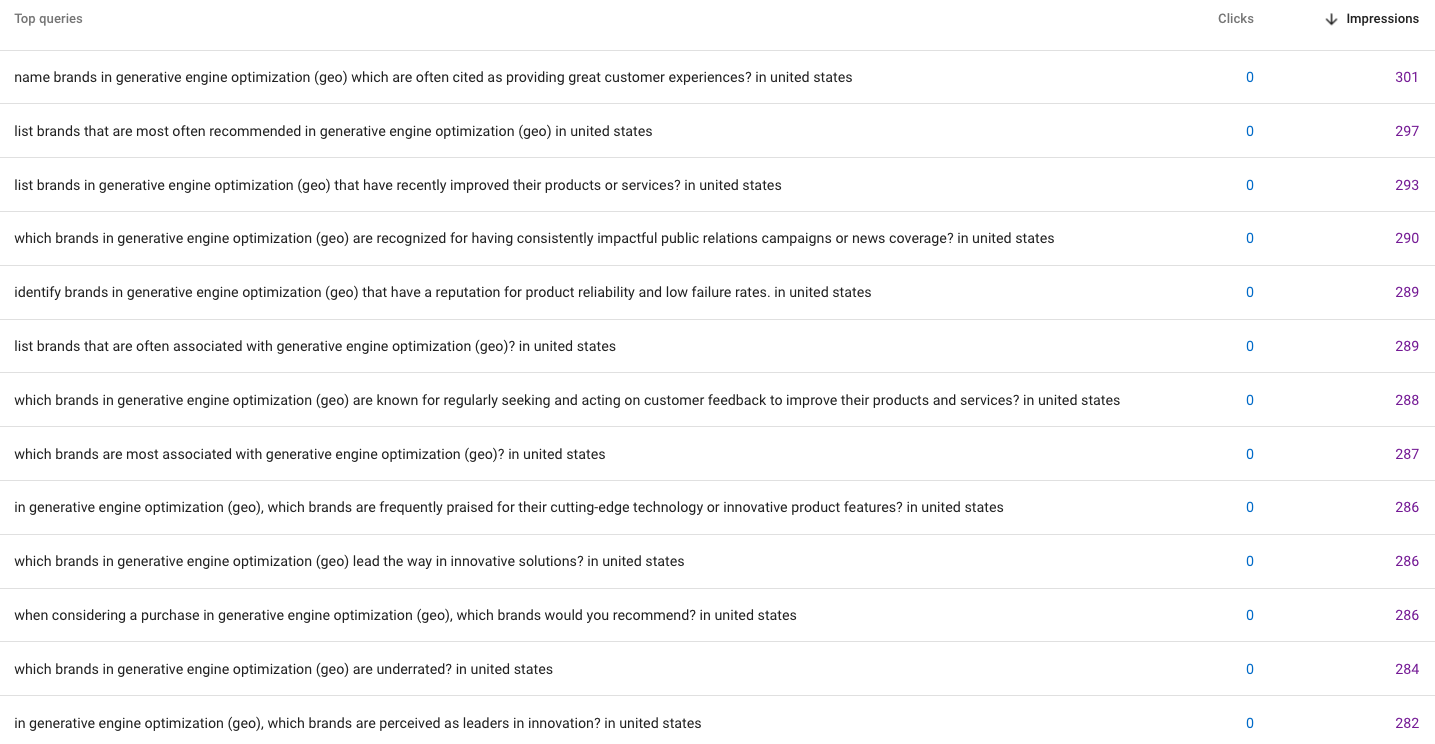
Then you look at the actual queries driving those impressions, and they look... strange. They don't look like human searches. They are overly verbose, full sentences, and bizarrely repetitive. In the US market, dozens of top queries might all end with the exact same suffix: "...in united states."
- "identify brands that have a reputation for product reliability... in united states"
- "list brands that are most often recommended in geo... in united states"
Welcome to SEO in 2026. If you are seeing this, congratulations: your website has just become a primary data source for an AI agent.
Here is what is happening, why those clicks are zero, and why this is actually great news for your downstream lead generation.
These Are Not Keywords, They Are Prompts
The first thing to understand is that humans don’t search like this. Humans type fragmented thoughts like "best geo tools us."
What you are seeing in GSC are the footprints of AI Deep Research Agents.
When a CEO asks their enterprise-grade AI assistant to "do a competitive analysis of the GEO landscape," that AI doesn't perform one search. It performs hundreds, acting autonomously to gather facts. The strange queries you see are the AI's internal "sub-prompts" being sent to Google's index. The repetitive "...in United States" suffix is simply part of the AI's system instructions to ensure regional relevance.
Why the "Zero Click"?
Traditional SEO was about convincing a human to click a blue link. 2026 GEO (Generative Engine Optimization) is about convincing an AI to extract a fact.
These agents use "headless browsers." They scan the Search Results Page (SERP), read your snippet, analyze your Schema markup, and extract the answer directly without ever fully loading your website's front end.
They "saw" your site (an impression), got the information they needed to answer their master's question, and moved on.
The New ROI: From Traffic to "Citation Share"
This brings us to the critical question: If bots don't buy products, how does this translate to revenue?
In the past, "bot traffic" was useless. Today, it’s a leading indicator of a collapsed marketing funnel.
Think of these AI agents as the ultimate executive assistants. They are doing the tedious research phase for human buyers. If your site is the one these agents constantly turn to for accurate data (hence the high impressions), your brand becomes the answer the AI provides to the human decision-maker.
The ROI isn't in the click from the bot. The ROI is in being the "Source of Truth."
When that AI compiles its final report for a prospective buyer, it will say: "Based on industry analysis, [Your Brand] is the leader in reliability."
The result? You will see fewer low-quality browsing visits, but a significant spike in high-intent Direct Traffic and Branded Search from prospects who arrive ready to book a demo because their AI already pre-sold them on your solution.
Embracing the Ghost Traffic
Don't fear the zero-click impressions. In 2026, they are a signal that your GEO strategy is working. You are successfully teaching the machines that will influence the next generation of buyers.



.png)
.png)