"From a technical - and human - standpoint, Hop AI are a fantastic team to work with. Their attention to detail, account management and expertise genuinely make them one of the best agencies we've ever worked with. It's been an incredible collaboration. We couldn't recommend Hop AI enough."
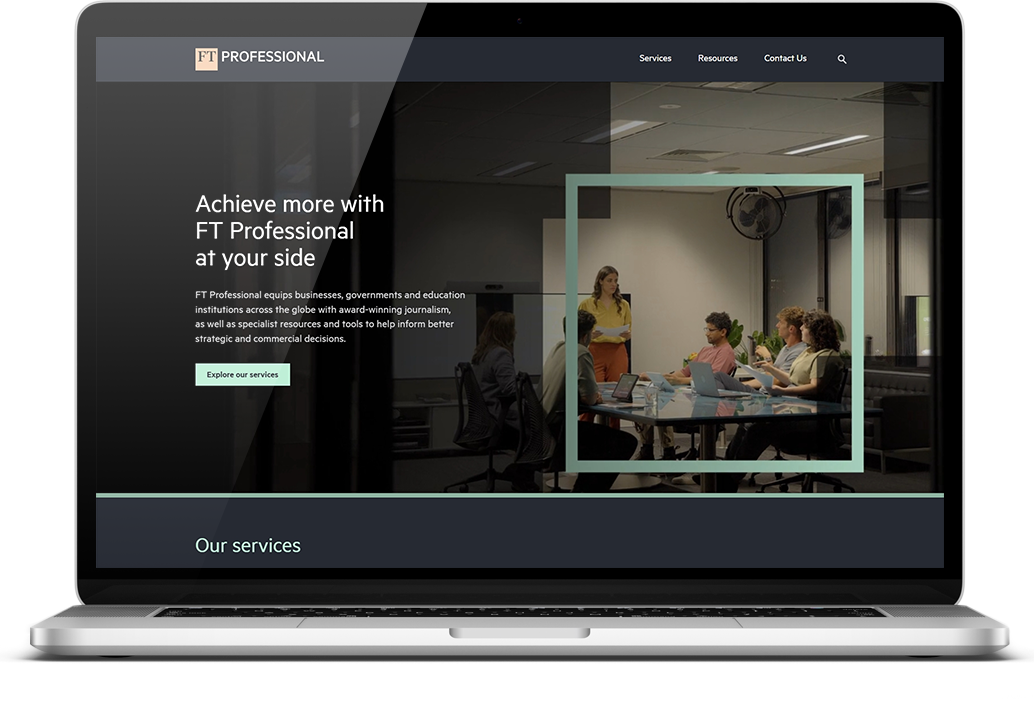
FT Professional is the B2B subscription arm of the Financial Times - delivering premium business intelligence, analysis and expert commentary to professionals and organisations worldwide. When Hop AI began working with their team, a clear opportunity existed: a well-known editorial brand with a limited digital marketing function, operating in a category where well-funded competitors were investing heavily in paid media at scale.
FT Professional sits at the intersection of premium editorial and professional development - a powerful value proposition for B2B buyers during periods of economic uncertainty and technological change. Market conditions were particularly favourable, with professionals actively seeking the certainty and credibility the FT brand provides. The opportunity was to activate this latent demand at pace and at scale, across multiple geographies and platforms.
Before the partnership began, FT Professional's digital marketing capability was constrained in scale, with limited brand awareness in the paid media space. There was no mature multi-channel infrastructure, limited campaign data to optimise against, and no tested creative playbook. Competitors with larger budgets were already well-established. The team needed a partner that could build from the ground up and compete smartly - not just spend more.
How do you build a high-performing paid media engine for a premium B2B brand - across multiple platforms and geographies - when you're starting with limited infrastructure, low brand recognition in the channel and a budget well below the competition? And how do you prove the model before scaling investment?
Rather than chasing short-term results, Hop AI took a structured, phased approach - building the infrastructure first, gathering data second, and only scaling once the model was proven. This discipline is what made our results possible.
First, Hop AI built the paid media account from the ground up - establishing robust campaign structures across all platforms, configuring conversion tracking, setting up audience frameworks, and creating the technical infrastructure needed to gather meaningful data. This phase was about doing the foundational work that makes everything else possible.
Next, the focus shifted to structured experimentation - running controlled tests across creative formats, audiences, channels and messaging to identify what resonates with FT Professional's target buyers. Each test generated data that informed the next decision, and the data accumulated into a clear, evidence-based strategic playbook that competitors simply could not replicate.
Armed with a proven strategic framework, Hop AI activated the full acquisition funnel at scale: awareness campaigns across both Paid Social and Pay-Per-Click reaching millions of professionals; mid-funnel activity to nurture those audiences; and bottom-of-funnel campaigns to capture high-intent buyers at the moment of decision. All channels were managed as a single, interconnected system rather than in isolation.
The time to strike: applying two years of learning to scale proven tactics with confidence. The strategy built and refined through the foundation and testing phases was deployed at full scale - across regions, audiences and all platforms simultaneously. The result: Paid Social delivered both a 67% drop in cost per lead and a 70% surge in lead volume simultaneously, while Pay-Per-Click captured the revenue that the upstream channels created.
The most important insight from this engagement is that no single channel drives revenue alone. Each channel plays a specific role in a coordinated system - and understanding those roles is what separates a high-performing account from a fragmented spend.
Each part of the funnel had a distinct job to do - and each delivered when measured against the right benchmark. In Q1 2026, Hop AI's full-funnel approach generated millions of impressions and drove a meaningful volume of closed revenue each quarter.
Strong paid media results don't come from access to tools or platforms - every agency has the same tools. They come from how a team thinks: about audiences, about creative, about data and about the relationship between channels. These are the principles that drove FT Professional's performance.
Every creative decision was the product of two years of controlled testing. Hop AI continuously analyses which content themes, formats and messaging angles resonate with each audience - and invests accordingly. This means the creative that reaches buyers at scale has already been validated, dramatically reducing wasted spend and improving performance consistency.
Across B2B paid media, the format in which content is delivered has a significant effect on how buyers engage and convert. Hop AI tests relentlessly across ad formats to identify which ones drive genuine buyer intent - not just clicks. In this engagement, identifying the highest-performing format for FT Professional's audience was one of the most impactful decisions in the entire campaign.
B2B buyers are time-poor. Copy that is clear, confident and respectful of the reader's attention consistently outperforms copy that tries to explain everything at once. Hop AI applies this principle across every channel and every market - testing copy ruthlessly and retiring anything that does not earn its place in the account.
Reaching the right professional with the right message at the right moment is worth far more than reaching a large audience with a generic one. Hop AI's audience strategy is built around precision - identifying the segments where FT Professional's value proposition is most compelling, and concentrating investment where it is most likely to convert into closed revenue.
Hop AI refused to scale spend before the foundations were solid. We took the time to build the accounts properly - not just chasing numbers. That discipline meant that when the moment arrived, we had the conversion data, audience insight and creative learning to optimise against and truly scale. There are no shortcuts to this phase - only agencies willing to do it properly deliver the results that follow.
The most important strategic insight: certain, specific ad formats do not work on their own. You need multiple campaigns to create the demand and then capture it. By managing all these channels as a single interconnected system - rather than optimising each in isolation - Hop AI maximised the return from every ounce of budget.
The decisions that drove performance were not based on instinct or convention. Each one was validated by real performance data from real FT Professional campaigns, built up over two years of structured testing. This is the advantage that compound investment in data creates - and it cannot be replicated by a new agency arriving with fresh ideas.
The Financial Times highlighted Hop AI's flexibility, communication and technical depth as key factors in the relationship's success. Hop AI embeds into the client's ways of working rather than operating at arm's length - managing the technical detail across tracking, campaign hygiene and platform monitoring that most clients never see but that directly protects performance and account health.