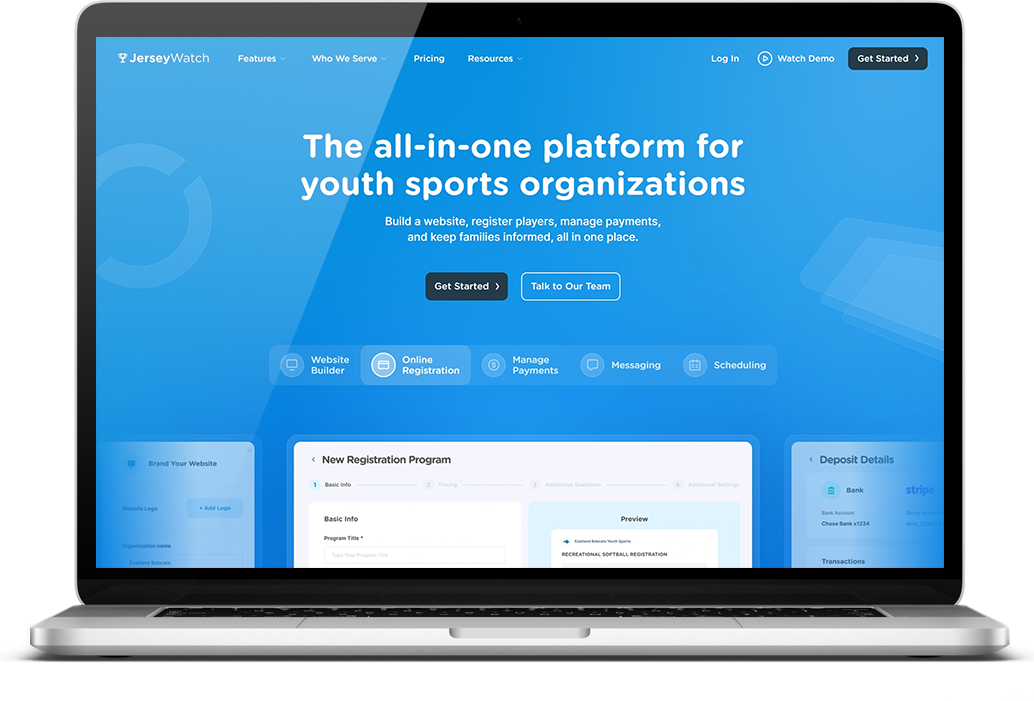
Jersey Watch is a SaaS platform built for youth sports organizations — covering website building, team registration, and integrated payments in one place. The platform serves leagues and clubs across football, soccer, baseball, basketball, volleyball, softball, cheerleading, and lacrosse across the US and Canada. With strong product-market fit and a clearly defined audience of coaches, club directors, and league administrators, the commercial opportunity was significant — but the paid acquisition stack needed a structural overhaul to unlock it.
Each channel came in with a different problem that required its own diagnosis and solution.
The audit revealed several compounding structural problems: duplicate conversion signals from overlapping GA4 and Google Ads tracking giving the algorithm misleading data, campaigns running on Manual CPC at keyword level despite having conversion goals, budget distribution that was restricting algorithm learning, and ad copy with duplicates and incomplete asset components well below best-practice standards.
The account had no proper conversion tracking in place — yet campaigns were simultaneously set to optimise for conversions. This is a fundamental conflict: asking the algorithm to maximise an outcome it has no reliable way to measure. Without clean conversion data, every automated bidding decision was built on guesswork, generating spend without meaningful signal and making it impossible to understand what was actually working.
Meta had been active since 2023 but had contracted to a single remarketing-only strategy. The problem was structural: retargeting by definition limits the addressable audience to only those who have already visited the website — a small, repeatedly cycled pool that inflates costs over time and caps growth. There were no prospecting campaigns reaching new audiences. The channel had no path to scaling because it had no mechanism for introducing genuinely new users into the funnel.
Rebuilding three channels simultaneously — each with a different structural failure — without sacrificing performance during the transition. Google had duplicate conversion tracking poisoning its algorithm and campaigns running the wrong bidding strategies for their goals. Microsoft was optimising for conversions with no conversion tracking in place. Meta had retreated entirely into retargeting, limiting its reach to a small recycled audience with no prospecting engine to grow from.
Hop AI's approach was structural before it was tactical. The belief: no amount of bid management or creative testing fixes a campaign that is pointed at the wrong audience or organized around the wrong logic. Each channel needed to be rebuilt around intent-matched targeting before optimization could compound.
Before changing anything, Hop AI conducted a thorough audit across all three platforms — assessing campaign architecture, bidding logic, conversion tracking integrity, and audience framework. The goal was to identify the root cause of underperformance on each channel rather than treating symptoms. This audit shaped every decision that followed.
On Google, the data foundation was fixed first — removing duplicate conversion imports and giving the algorithm clean, reliable signals to learn from. Campaigns were then restructured with conversion-based bidding replacing manual CPC, and ad copy rebuilt to eliminate duplicates and align to keyword intent. On Microsoft Ads, proper conversion tracking was implemented before anything else — resolving the fundamental contradiction of optimising for an outcome the account couldn't measure — then campaigns and bidding strategies were restructured to match.
The strategic shift on Meta was from retargeting to prospecting. A channel confined to remarketing can only recycle the same small pool of existing visitors — it has no mechanism for growth and no way to introduce new users into the funnel. Hop AI built precisely targeted prospecting campaigns designed to reach net-new audiences of sports organization administrators who had no prior exposure to Jersey Watch. Combined with systematic placement testing, Audience Network exclusion, and continuous audience refinement based on conversion data, the channel gained the ability to scale that a retargeting-only strategy fundamentally cannot provide.
Conversion tracking was consolidated to precise new event signals — sign_up and organization_subscription_create — giving bidding algorithms clean, reliable data to learn from. Weekly optimisation cycles across all three channels ensured budget flowed toward what was working and each adjustment compounded into the next. Monthly cross-channel reporting kept the full picture visible and every decision accountable.
The rebuilt architecture turned a single, undifferentiated account into twelve focused campaigns, each speaking directly to a specific sports community with the right keywords, the right message, and the right bid strategy. Rather than competing for generic "sports software" searches, every campaign was built to intercept the exact moment a league director or club coordinator was actively searching for a solution — and convert that intent into a sign-up.
The Microsoft account was caught in a contradiction that undermined every automated decision it made: campaigns were set to optimise for conversions, but no conversion tracking was properly in place. The algorithm was optimising toward an outcome it couldn't see. Fixing that — establishing clean, reliable conversion signals — was the prerequisite for everything else. Once the data foundation was sound, the campaigns could be restructured around conversion-based bidding strategies and sport-specific targeting, and the channel could start delivering on the performance its budget was intended to achieve.
A retargeting-only strategy has a hard ceiling: it can only work with the audience already in the funnel, and it degrades over time as that pool gets repeatedly cycled. The rebuild introduced prospecting campaigns specifically designed to reach sports organization administrators with no prior awareness of Jersey Watch — expanding the addressable audience and building a genuine acquisition engine. Precisely targeted, placement-tested, and continuously refined against real conversion data, Meta shifted from a channel that recycled existing visitors to one that consistently introduced new prospects into the funnel.
Verified review by Tim Gusweiler, Co-Founder of Jersey Watch — published April 14, 2026 on Clutch.co
The improvements across all three channels didn't come from bid tweaks or creative tests — they came from rebuilding the architecture first. Administrators across different sports disciplines have different search intent, different seasonality, and different messaging needs. Treating them the same was the original failure. Treating them separately was the fix. Every campaign restructure created the conditions for optimisation to actually work.
The Meta rebuild wasn't about finding a better audience within retargeting — it was about escaping the fundamental limitation of retargeting altogether. A channel confined to remarketing can only recycle existing visitors; it has no mechanism for net-new growth and its costs inflate as the same pool gets repeatedly reached. Introducing precisely targeted prospecting campaigns gave the channel a genuine acquisition engine. The same principle applied across search: targeting by sport-specific intent rather than broad terms meant reaching administrators who were actively looking, not generic traffic that happened to pass through.
Smart bidding strategies can only perform as well as the conversion signals feeding them. Consolidating tracking to precise, consistent conversion events gave the algorithms what they needed to optimise toward genuine business outcomes rather than ambiguous proxy metrics. Cleaning the data wasn't a housekeeping task; it was a performance lever.
No single change produced the results. What produced the results was a consistent cadence of weekly decisions — budget reallocation, negative keyword additions, placement exclusions, audience refinements — each one informed by the previous week's data. Over five months, those decisions compounded. The discipline wasn't in any individual optimisation; it was in never letting a week pass without the account getting meaningfully better.