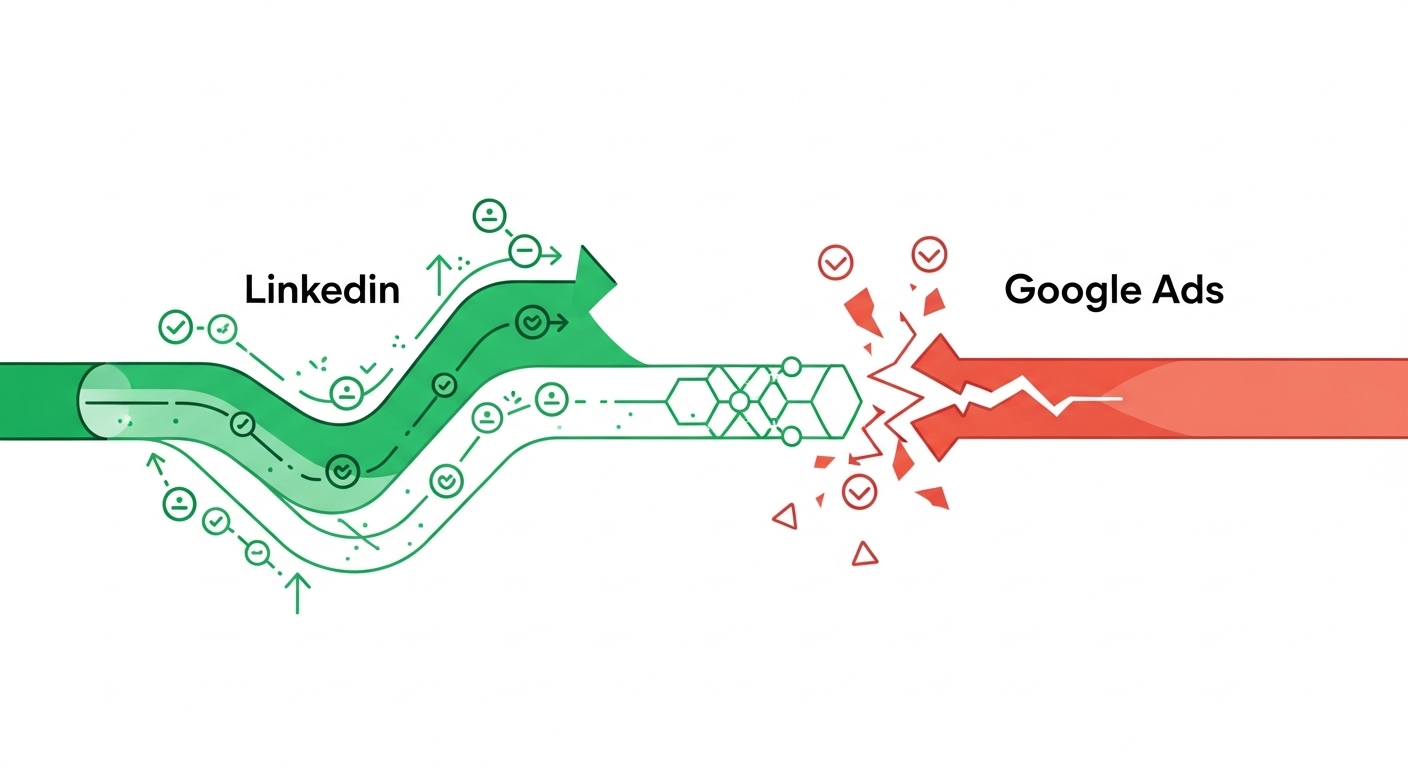
When your LinkedIn campaigns are humming along, generating steady engagement and filling your pipeline, but Google Ads performance suddenly tanks — what do you do? The instinctive response for most demand gen leaders is to shift budget away from the underperforming channel toward the winner. Cut Google, double down on LinkedIn. It's logical, data-driven, and in most cases, completely wrong.
This scenario plays out constantly in B2B marketing, particularly in complex, high-consideration categories like cybersecurity. One channel shows strength while another falters, creating what appears to be a clear signal about where to allocate resources. But this surface-level analysis misses a fundamental truth about modern multi-channel marketing: your channels don't operate independently. They form an interconnected ecosystem where cutting one channel doesn't just affect that channel — it cascades through your entire demand generation engine.
We've observed this pattern repeatedly in our work with cybersecurity clients. In one case, a client saw LinkedIn document ads generating 50% of all leads while Google Ads costs per conversion climbed steadily. The obvious move seemed to be reallocating budget from Google to LinkedIn. But when we analyzed the actual customer journey, we discovered something critical: Google's brand search volume was directly dependent on the awareness LinkedIn generated. The channels weren't competing — they were cooperating.
The relationship between awareness-focused channels like LinkedIn and intent-capture channels like Google Search is more symbiotic than most attribution models reveal. When someone sees your LinkedIn ad highlighting a new threat intelligence platform, they don't immediately convert. They might ignore it. But three weeks later, when they're researching solutions to a specific security gap, they remember your brand and search for it directly in Google.
In traditional last-click attribution, Google gets credit for that conversion. The LinkedIn impression that planted the seed? Invisible. This creates a dangerous illusion: Google appears to be the efficient performer while LinkedIn looks expensive. But the reality is that Google's efficiency depends entirely on LinkedIn's awareness-building work.
We documented this exact dynamic in a quarterly analysis for a media client. LinkedIn and Google Ads had both driven strong performance early in the year, with Google maintaining a significantly lower cost per lead. But when we examined the data more closely, we found that "impressions and clicks and ad spend" were all increasing, yet "conversions and conversion rate decreased and cost per conversion increased" — simultaneously across both platforms.
This wasn't a coincidence. The channels were experiencing the same underlying market dynamics: increasing competition, audience saturation, and creative fatigue. But more importantly, they were interconnected. As one team member noted in our analysis: "LinkedIn's performance and Google Ads performance are kind of linked in that sense. They sort of cohabitate."
The fundamental problem is that most marketing organizations measure channel performance in isolation. Each channel has its own dashboard, its own KPIs, and its own budget owner. LinkedIn is measured on cost per lead. Google is measured on cost per conversion. Display is measured on impressions and reach. This siloed measurement creates siloed decision-making.
But your buyers don't experience channels in isolation. They experience your brand across multiple touchpoints over weeks or months. A cybersecurity buyer might:
In a last-click model, Google gets 100% of the credit. In a first-click model, LinkedIn gets it all. Both are wrong. The reality is that all five touchpoints contributed to the conversion, and removing any one of them would have reduced the probability of conversion.
This is why cutting LinkedIn budget to fund more Google Ads often backfires. You're not reallocating from an inefficient channel to an efficient one — you're cutting the fuel that powers your "efficient" channel. As we explained to one client facing this exact scenario: "If we cut back in LinkedIn, invest more in Google, Google will not have the volume it needs to grow. So that scaling effort we think would stall."
Cross-channel performance divergence isn't always about interdependence, though. Sometimes it reveals genuine problems that require different solutions. The key is understanding what's driving the divergence.
When we analyzed performance for a B2B media client, we noticed a troubling pattern: "spike in costs in late 2025, that suggests that there is some... the current prospecting audience is becoming saturated or the competition is rising." Competitors including major business publications had started using the same ad formats, particularly document download ads, creating audience fatigue and driving up costs.
This type of divergence — where costs increase while engagement metrics remain stable — signals that you're competing harder for the same finite attention. The solution isn't budget reallocation; it's creative refresh, audience expansion, or format innovation.
Performance divergence often manifests geographically. In our analysis, we identified "regional pipeline weakness" where "the Americas region, it's got a notably poor conversion rate from MQL to SQL." This wasn't a channel problem — it was a regional go-to-market problem. Both LinkedIn and Google were generating leads in the Americas, but those leads weren't converting to pipeline at the same rate as other regions.
Reallocating budget between channels wouldn't fix this. The issue required examining regional sales processes, lead qualification criteria, and potentially the product-market fit in specific geographies.
The most dangerous form of divergence is what we call "structural cost disparity." This occurs when one channel has inherently higher costs per lead than another, creating what appears to be a performance gap but is actually a function of where the channel operates in the funnel.
As one of our strategists explained: "clients tend to measure success by cost per lead. But when we do the awareness, it's more of a long term play and it also helps the other channels because someone might see the ad in LinkedIn for example, and then look up [the brand] from Google or direct traffic. So everything is very interconnected."
LinkedIn's document ads might generate leads at $800 each while Google brand search delivers them at $200. But if you eliminate the LinkedIn campaigns, your Google brand search volume drops by 60%, and suddenly you're spending the same total budget for far fewer leads. The structural cost difference wasn't a bug — it was a feature of how the channels work together.
The solution to cross-channel divergence isn't to ignore cost differences or avoid budget optimization. It's to build a more sophisticated approach to budget allocation that accounts for channel interdependence while maintaining the flexibility to respond to performance signals.
Start by mapping the actual customer journey. Use multi-touch attribution tools, but supplement them with qualitative research. Survey recent customers about their buying journey. Which touchpoints do they remember? What sequence did they follow? This gives you a baseline understanding of how your channels interact.
For one client, we discovered that their target account strategy required LinkedIn: "he really wanted us to focus on those accounts... a thousand accounts that he gave us as prospects. So the only way to really go after them is actually on LinkedIn. So this is why we decided to put more of the spend towards LinkedIn."
This wasn't about LinkedIn being "better" than Google — it was about LinkedIn being the only channel that could execute the required strategy. Understanding this interdependence prevented misguided budget cuts.
Not every channel should be measured on cost per lead. Awareness channels like LinkedIn sponsored content should be measured on reach, engagement, and their impact on downstream conversion rates. Intent-capture channels like Google Search should be measured on conversion efficiency and volume.
We implemented this approach with a cybersecurity client by splitting their LinkedIn budget across three campaign types with different objectives: "Legion is document ads with lead magnets, then brand awareness is focused on impressions and reach, and then conversions is focused getting demo form submits."
Each campaign type had its own success criteria. The brand awareness campaigns weren't expected to deliver $200 cost-per-lead performance — they were expected to increase branded search volume and improve conversion rates on other channels.
Rather than allocating fixed budgets to each channel, establish minimum and maximum thresholds based on strategic objectives. For example:
These guardrails prevent reactive budget cuts while allowing tactical flexibility. When Google performance improves, you can scale it up within the defined range. But you can't gut LinkedIn to fund that scale-up, because LinkedIn's minimum threshold protects the awareness engine that feeds Google.
Before making significant budget shifts, model the likely outcomes. If you cut LinkedIn budget by 30%, what happens to: - Branded search volume in Google? - Overall website traffic? - Conversion rates on other channels? - Sales cycle length?
We use this approach with clients facing budget pressure. Rather than making cuts based solely on cost per lead, we model the full ecosystem impact. Often, this reveals that the "expensive" channel is actually the most cost-effective when you account for its impact on other channels.
Traditional attribution models fail in complex B2B environments because they're designed for simple, linear journeys. Multi-touch attribution is better, but it still struggles with long sales cycles and multiple decision-makers.
We've found success with position-based attribution models that assign different weights to different touchpoints, but with channel-specific multipliers. For example:
But then apply channel multipliers based on strategic role: - Awareness channels (LinkedIn Sponsored Content): 1.2x multiplier on first-touch credit - Consideration channels (Content Syndication): 1.1x multiplier on middle-touch credit - Intent channels (Google Search): 1.2x multiplier on last-touch credit
This approach recognizes that not all touchpoints are equal, and that channels performing their strategic role effectively deserve credit even if they're not the last click.
The gold standard for understanding channel interdependence is incrementality testing: deliberately pausing or reducing spend in one channel while measuring the impact on others. This is expensive and risky, but it provides definitive answers about channel relationships.
We conducted this test with a client who believed their Google Search campaigns were independently effective. We reduced LinkedIn spend by 40% for four weeks while maintaining Google at full budget. The result: Google conversions dropped 28%, and cost per conversion increased 35%. The channels were far more interdependent than the attribution model suggested.
Track cohorts of leads based on which channel combinations they experienced. Compare conversion rates, sales cycle length, and deal size for:
This reveals which channel sequences produce the highest-quality pipeline. In our experience, leads that touch both awareness channels (LinkedIn) and intent channels (Google) typically convert at 2-3x the rate of single-channel leads and close deals 25% faster.
When you detect cross-channel performance divergence, here's a systematic approach to diagnosis and response:
Is this: - Inverse correlation (one channel up, one down)? Suggests potential interdependence or budget cannibalization. - Parallel decline (both channels down)? Suggests market-level factors like seasonality, competition, or creative fatigue. - Parallel growth at different rates (both up, but one faster)? Suggests you're in a growth phase and should double down on the faster channel while maintaining the baseline on the slower one.
Before adjusting budgets, examine leading indicators: - Search volume trends for branded and non-branded terms - Website traffic patterns by source - Engagement metrics (time on site, pages per session) by channel - Sales cycle length and conversion rates by channel
If LinkedIn costs are rising but branded search volume is also rising, the channel is working — it's just getting more expensive. If LinkedIn costs are rising while branded search volume falls, you have a creative or targeting problem.
In the case we analyzed where both Google and LinkedIn showed declining conversion rates, the team's first response was to test new creative: "I've changed last week actually I added additional ad copy to replace the underperforming one." When that didn't work, they moved to "change the ad copy again" and consider new images.
This is the right sequence: creative refresh → audience expansion → format testing → budget reallocation. Budget shifts should be the last resort, not the first response.
If you must reallocate budget, do it gradually and measure the impact:
Week 1-2: Shift 10% of budget from underperforming channel to strong channel. Monitor conversion volume and cost across all channels.
Week 3-4: If strong channel maintains efficiency and underperforming channel doesn't deteriorate further, shift another 10%.
Week 5-6: Measure total pipeline impact. Has overall lead volume increased? Has cost per opportunity improved? Has sales cycle length changed?
This incremental approach prevents catastrophic errors while giving you real data about channel interdependence.
For cybersecurity companies, cross-channel orchestration is particularly critical because the buying journey is uniquely complex. Security purchases involve multiple stakeholders (CISO, SOC team, IT leadership, procurement, legal), long evaluation cycles (often 6-12 months), and high consideration given the risk of choosing the wrong solution.
This creates several specific challenges:
A security professional might see your LinkedIn ad about threat detection in January, attend your webinar in March, download a comparison guide in May, and finally request a demo in August. Traditional 30-day attribution windows miss most of this journey.
We recommend 180-day attribution windows for cybersecurity campaigns, with particular attention to first-touch awareness activities. The LinkedIn campaign that seems "expensive" in January might be the seed that produces a six-figure deal in September.
Most cybersecurity sales are account-based, with multiple contacts at target accounts engaging with your content. Your LinkedIn ads might reach the SOC Director, your Google Search ads might capture the CISO, and your display retargeting might influence the CTO.
This requires account-level attribution, not lead-level. Track engagement across all contacts within target accounts, and measure channel performance based on account progression, not individual lead conversion.
Security professionals are inherently skeptical and research-intensive. They don't convert on first touch — they evaluate, compare, and validate. This means your awareness channels need sustained investment even when they show high cost per lead, because they're building the credibility that enables eventual conversion.
As one strategist noted: "when we do the awareness, it's more of a long term play and it also helps the other channels." For cybersecurity brands, this long-term play isn't optional — it's the only way to build trust with a skeptical audience.
The shift from siloed channel management to integrated ecosystem orchestration requires changes in how you structure teams, set goals, and make decisions.
Structural Changes: Break down channel-specific teams and budget owners. Create cross-functional pods responsible for full-funnel outcomes, not channel-specific metrics.
Measurement Evolution: Move from channel-level dashboards to journey-level analytics. Track how channel combinations drive pipeline, not how individual channels perform in isolation.
Budget Philosophy: Treat your marketing budget as a portfolio, not a collection of line items. Some channels are growth stocks (high cost, high potential return). Others are bonds (stable, predictable performance). You need both, and cutting one to fund the other often reduces total portfolio value.
Decision Framework: Before any budget reallocation, ask: "What is this channel's strategic role, and what would happen to other channels if we reduced it?" If you can't answer that question with data, you're not ready to make the change.
The cybersecurity market is becoming more competitive, with multiple well-funded players fighting for the same buyer attention. In this environment, the companies that win won't be those with the most efficient individual channels — they'll be those that orchestrate their full channel ecosystem most effectively. When Google and LinkedIn show divergent performance, the answer isn't to pick a winner. It's to understand how they work together, and optimize the system, not the parts.